I'm sorry this is so late. It's the final countdown now, so I'm spending all my time working on my novel. I have to turn in a revised first draft tomorrow. The insanity is building. But, I can now say that I have had at least one person read my whole draft and give me feedback (the death and reversal at the end works. It works! Mwahahaha!) I am optimistic for how this novel will end up, when I'm finally done with it.
I'm currently living on free food on campus and the high I get from making a mediocre passage awesome. But, after I turn this draft in, I want to take a break from this story. I need to clear it from my mind so I can return to it later with a better idea of where it is and what it needs. So, over the next few weeks, I can take a break and do something else. What about one of these....
- Revise my term paper (this is going to happen. This has to happen, or all is lost)
- Revise any of the short stories I wrote this semester
- Work on the novel I put on the back burner to work on Alder Torrance
Okay, that's still a lot of writing. Writing is my life right now, and I love it, but when I get back to school after Christmas I'm going to start writing again. Maybe it would be good for me to put the Word documents aside and live my life, refreshing my writing lobe and gathering life experiences to build on. So, here's a list of things I could be doing other than writing:
- Sleeping
- Eating
- Thinking about real things
- Walking in a winter wonderland
- Sleeping
- Forgetting the large vocabulary I need to write with
- Getting asked by other people what large vocabulary words mean
- Making fudge
- Explaining to people why the fudge didn't make it to the pan
- Actually traveling in real time and space
- Watching Doctor Who
- Flinching at shadows and stone angels
- Getting psychiatric help because I talk to people who aren't there (and flinch at shadows and stone angels)
- Fully enjoying my insanity
- Hanging lights and loving every minute (see preceding item)
- Listening to lots of music
- Drag Racing
- Simply walking into Mordor
- Mocking the song "Christmas Shoes" for bad writing
- Eating a whole roll of Toll House Cookie Dough as fast as I can
- Quoting The Avengers
- Quoting Psych
- Volunteering for the Hunger Games
- Winning the Hunger Games
- Tracking down the owl that lost my letter to Hogwarts
AND....
- Spending time with friends and family, rather than fictional people
Well, that's quite the list. I'm sure I'll get to some of these over the break, but I'm sure writing will call me back before I can get to all of them. That's the writer's curse.
Wednesday, December 5, 2012

Tuesday, November 27, 2012
Review: "Rise of the Guardians"
I apologize for this being a day late, but I am now in my last few weeks of the semester and entering the time when I have more work than time or sanity. So, today, instead of pondering what makes good writing good, I'm going to review a movie I saw over the Thanksgiving holiday: Dreamworks' Rise of the Guardians.
I feel like this isn't as lazy as it could have been, since the movie is based on a book series by William Joyce, who also helped make the movie. The books are good, and you all should read them, but I'm going to talk about the movie.
Short response: I thoroughly enjoyed it.
By now, you should know that I reward "awesomeness" highly, which might not be my best trait. The movie was awesome, kind of an Avengers for children. I also really enjoy mythology of all kinds, so it was interesting to me to see how the mythological figures of Santa, Sandman, Easter Bunny, Tooth Fairy, and Jack Frost would interact, and what they would see as their purpose. Why deliver toys? Why take teeth and leave coins?
I was impressed by the depth they put into the protagonist, Jack Frost. From the trailers, it seems like Jack is not a central part of the story, that he's a wild, rebellious kid with no cares in the world, but that's not true. He has anxieties and fears that make him a fairly interesting character, and also allow for a fascinating (at least to me) parallel between him and the antagonist, Pitch. This film is actually a good example, I think, of the shadow: a character that is similar to the hero in many ways, but has fallen. A perfect example from the world of superheroes is Peter Parker/Spider-Man and Eddie Brock/Venom.
It makes it cooler to my English-major brain that the "shadow" in Rise of the Guardians is literally a shadow, namely, Pitch Black, the Nightmare King.
Other things I liked: the movie has a character who doesn't speak, who is still dynamic and compelling. I love characters who manage to have a strong presence without much dialogue. I also liked the bright colors, very imaginative and dreamlike, that sparked memories of childhood and the wonder, hope, and dreams that came with it. Also, I have never wanted to go ice skating or have a snowball fight so bad in my life.
Do I think it was as good as How to Train Your Dragon? No, I do not. The characters weren't as compelling, and the dialogue didn't sparkle as much. But I also think what we have here is a new story, with its own place in the world. It was a cute movie, and I would definitely see it again while it's still in theaters.
I feel like this isn't as lazy as it could have been, since the movie is based on a book series by William Joyce, who also helped make the movie. The books are good, and you all should read them, but I'm going to talk about the movie.
Short response: I thoroughly enjoyed it.
By now, you should know that I reward "awesomeness" highly, which might not be my best trait. The movie was awesome, kind of an Avengers for children. I also really enjoy mythology of all kinds, so it was interesting to me to see how the mythological figures of Santa, Sandman, Easter Bunny, Tooth Fairy, and Jack Frost would interact, and what they would see as their purpose. Why deliver toys? Why take teeth and leave coins?
I was impressed by the depth they put into the protagonist, Jack Frost. From the trailers, it seems like Jack is not a central part of the story, that he's a wild, rebellious kid with no cares in the world, but that's not true. He has anxieties and fears that make him a fairly interesting character, and also allow for a fascinating (at least to me) parallel between him and the antagonist, Pitch. This film is actually a good example, I think, of the shadow: a character that is similar to the hero in many ways, but has fallen. A perfect example from the world of superheroes is Peter Parker/Spider-Man and Eddie Brock/Venom.
It makes it cooler to my English-major brain that the "shadow" in Rise of the Guardians is literally a shadow, namely, Pitch Black, the Nightmare King.
Other things I liked: the movie has a character who doesn't speak, who is still dynamic and compelling. I love characters who manage to have a strong presence without much dialogue. I also liked the bright colors, very imaginative and dreamlike, that sparked memories of childhood and the wonder, hope, and dreams that came with it. Also, I have never wanted to go ice skating or have a snowball fight so bad in my life.
Do I think it was as good as How to Train Your Dragon? No, I do not. The characters weren't as compelling, and the dialogue didn't sparkle as much. But I also think what we have here is a new story, with its own place in the world. It was a cute movie, and I would definitely see it again while it's still in theaters.
Monday, November 19, 2012
Gimmicks: Use and Abuse
Happy Thanksgiving, all! I hope you're spending time with friends and family and a great deal of food. First off, I want to mention my publisher's Kickstarter campaign. It ends November 26, so time's running out. Support us. Tell your friends.
There are a lot of awesome movies coming out this holiday season. Lots of great books, too. Some of them have some excellent ideas behind them, which I would even characterize under "awesome". However, I feel like these interesting ideas can hinder a story instead of help it. They become "gimmicky" and the story never is able to move past them.
What do I mean? Let's look at several children's movies. The first is Hotel Transylvania, a movie about a hotel where monsters can go to feel safe from humans. I thought it was a cute movie, but when I left, I said, "I wish they didn't use so many monster gags." I felt like the whole story was only a frame to hang jokes about ghosts, skeletons, Frankenstein, mummies, etc., on. The movie was a string of jokes and references, leaving plot and characters to be underdeveloped. I'm not saying they weren't there, but they didn't shine. Plot was simple and predictable, and characters felt flat and equally predictable. The idea was clever and the movie, riding on its gimmick, was okay. But it could have been more.
I want to compare this to films like Toy Story, Monsters Inc., and the recent Disney movie Wreck-It Ralph. These three movies (note that 2 of them are Pixar) have unique and clever "gimmicks" as the frame for their stories: toys are alive and move around when you're not looking at them, monsters scare kids because it's their job and they're actually scared of children, and arcade game characters are doing a job and may not like what they've been programmed to do. These movies do make references and jokes about the gimmick, but what sets these movies apart is how compelling the characters are.
What it comes down to, what it always comes down to, is the characters and how they interact. The "gimmick" of the frame is clever and intriguing, but the story digs deeper. The story is no longer about the gimmick, but about the characters. The "gimmick" may be prevalent, but only as a way to display the characters and their motivations. For example, Toy Story is more about jealousy, shown by a favorite toy's (Woody) fall of popularity by a new, fancy toy (Buzz Lightyear), and friendship, as shown when Woody and Buzz get lost and have to find their way home.
The gimmick is not the focus of the story; the interactions are. I guess the rule of thumb here is: can the same story be told in a different setting, with a different frame, and still be interesting? If not, it's relying on a gimmick. Toy Story would still be interesting because the draw is the relationship between Woody and Buzz. The same goes for the other films.
What does this mean for writing? Come up with a fantastic idea, something unique and compelling. Something other people don't think of. We're writers; we're creative. This is our job. But don't stop there. Figure out how the compelling idea would mold compelling characters, and then tell their story. It will be much more interesting.
There are a lot of awesome movies coming out this holiday season. Lots of great books, too. Some of them have some excellent ideas behind them, which I would even characterize under "awesome". However, I feel like these interesting ideas can hinder a story instead of help it. They become "gimmicky" and the story never is able to move past them.
What do I mean? Let's look at several children's movies. The first is Hotel Transylvania, a movie about a hotel where monsters can go to feel safe from humans. I thought it was a cute movie, but when I left, I said, "I wish they didn't use so many monster gags." I felt like the whole story was only a frame to hang jokes about ghosts, skeletons, Frankenstein, mummies, etc., on. The movie was a string of jokes and references, leaving plot and characters to be underdeveloped. I'm not saying they weren't there, but they didn't shine. Plot was simple and predictable, and characters felt flat and equally predictable. The idea was clever and the movie, riding on its gimmick, was okay. But it could have been more.
I want to compare this to films like Toy Story, Monsters Inc., and the recent Disney movie Wreck-It Ralph. These three movies (note that 2 of them are Pixar) have unique and clever "gimmicks" as the frame for their stories: toys are alive and move around when you're not looking at them, monsters scare kids because it's their job and they're actually scared of children, and arcade game characters are doing a job and may not like what they've been programmed to do. These movies do make references and jokes about the gimmick, but what sets these movies apart is how compelling the characters are.
What it comes down to, what it always comes down to, is the characters and how they interact. The "gimmick" of the frame is clever and intriguing, but the story digs deeper. The story is no longer about the gimmick, but about the characters. The "gimmick" may be prevalent, but only as a way to display the characters and their motivations. For example, Toy Story is more about jealousy, shown by a favorite toy's (Woody) fall of popularity by a new, fancy toy (Buzz Lightyear), and friendship, as shown when Woody and Buzz get lost and have to find their way home.
The gimmick is not the focus of the story; the interactions are. I guess the rule of thumb here is: can the same story be told in a different setting, with a different frame, and still be interesting? If not, it's relying on a gimmick. Toy Story would still be interesting because the draw is the relationship between Woody and Buzz. The same goes for the other films.
What does this mean for writing? Come up with a fantastic idea, something unique and compelling. Something other people don't think of. We're writers; we're creative. This is our job. But don't stop there. Figure out how the compelling idea would mold compelling characters, and then tell their story. It will be much more interesting.
Tuesday, November 13, 2012
Awesomeness
First off, there is a week left in my publisher's Kickstarter campaign. Show interest! Tell your friends! We'll all thank you if we can make our goal.
Second, I want to talk about awesomeness in writing. When I say "awesomeness" I mean a very specific trait. I don't mean what you, as the writer, like. I know a lot of people who geek out over Renaissance literature, and while writing that into a novel will be fine and dandy for them, I don't think it would count as awesomeness. So, what is awesomeness, and why should writers care about it?
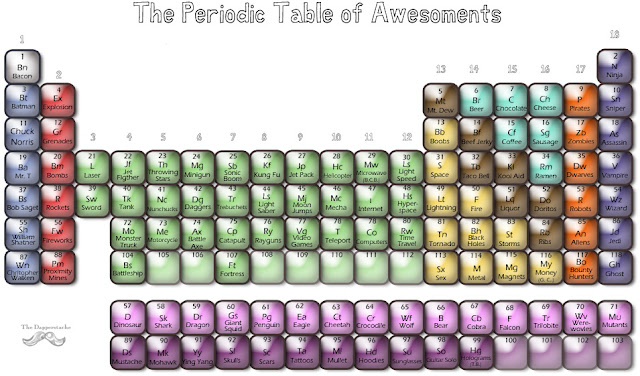
The idea for this post comes courtesy of a classmate who brought this to class.
Second, I want to talk about awesomeness in writing. When I say "awesomeness" I mean a very specific trait. I don't mean what you, as the writer, like. I know a lot of people who geek out over Renaissance literature, and while writing that into a novel will be fine and dandy for them, I don't think it would count as awesomeness. So, what is awesomeness, and why should writers care about it?
The idea for this post comes courtesy of a classmate who brought this to class.

This is a clever list of elements that are generally considered awesome by the public. It's a little dated (mullet? really?), but a lot of these are still awesome.
Here's my definition of "awesomeness": it's the collection of ideas that make you, the writer, and the reader smile and go, "Ooh." These are the things we never quite grow out of being interested in. As a child, we like spectacle, magic, superpowers, royalty, epic battles, and time travel. Which is why I think Doctor Who is so popular. Try to imagine a child, teenager or young adult going to a movie. What are they going to talk about when they come out? Will it be the scintillating dialogue or the deep symbolism? Not likely. They're going to talk about the jokes, explosions, and ninjas.
I'm not advocating throwing literary writing to the wind in pursuit of what will sell. But that which is "awesome" does sell. It keeps readers interested in the story, which is not a bad thing. You can have the most symbolic, high-brow story every written, but what good does it do anyone if no one reads it? The Elements of Awesomeness are also valuable in that many of them introduce conflict or are signs of conflict that already exists. Stories thrive on conflict, especially certain genres.
Final point: when writing an adventure, fantasy, science fiction, thriller, etc., anything that is meant to raise the reader's heartbeat and keep them from putting down the book, add awesome. Keep the thrill ride going. For introspective stories that focus on the importance of the mundane, remove these from the story. You want the reader to find the meaning of small moments, and they can't do that if your hero is walking in slo-mo away from an exploding building.
Tuesday, November 6, 2012
Gut Reactions
Happy November, everyone! I hope everyone's having a good time with the new month, now that the horror posts of Halloween are over. I'm planning some posts about warm, happy stories, but sadly, today is not one of those days. I want to talk about what to do when, in writing a story, you have to describe a physical sensation your narrator is going through.
Personally, I think this is difficult. For one thing, when the narrator is looking at another character who, say, feels like he's going to throw up, he can describe what that person looks like, and it's relatively harmless to do that. Most of the time, when someone is sick, his face turns pale and he sags, right? However, when describing nausea from the narrator's view, you have to describe it more in depth: the illness, the pain, the constant worrying that she, the narrator, is going to lose it. You have to do this in the voice your narrator would use, and much of the time, you have to know how it feels. It greatly helps when writing about feeling sick if you've felt sick.
This is another snag I come up against when writing my narrator's reactions to things. Not just physical illness, but also emotional reactions. I live a very comfortable life. I don't remember breaking any bones, and I haven't been hurt or sick all that much. I haven't experienced crippling loss or mental illness. So, how on Earth can I write from the perspective of characters who have? I can't go out and break an arm every time I want to write about a character who gets injured in that way, and, obviously, I wouldn't want to.
I guess this all comes down to the whole "write what you know" thing. The question I raise is this: is it important to have experienced personally everything your characters go through? I don't think you can, especially when you write fantasy or adventure. Most writers live normal, boring lives, at least, outside their heads. Sometimes you have to bridge the gap between what you know and what your characters know.
So how to fix this? Well, there are some ways I use. Currently, I am writing from the perspective of a character who has panic attacks. I don't get panic attacks, so this is the first thing I do when writing from his viewpoint: I mentally go back to a class I took on psychology, where I learned the symptoms of a panic attack. A lot of writers, when they don't have the personal experience, do research. Interviews, fact sheets, anything they can use to make the writing seem true to what a real life experience would be like. The other thing I do is enhance the experience I do have. I may not know what a panic attack feels like, but I know what it's like to be afraid, and all the physical sensations that come with it.
Combining the two, I feel I can make an accurate portrayal of what a panic attack would feel like for someone experiencing it. This, like everything else on this blog, is just my opinion and personal style of writing. And, as always, I'd be interested to hear other views, so comment away and I'll see you again next week. Don't forget to check out my publisher's Kickstarter. My book, The Shifting, is one of the $25 pledge gifts.
Personally, I think this is difficult. For one thing, when the narrator is looking at another character who, say, feels like he's going to throw up, he can describe what that person looks like, and it's relatively harmless to do that. Most of the time, when someone is sick, his face turns pale and he sags, right? However, when describing nausea from the narrator's view, you have to describe it more in depth: the illness, the pain, the constant worrying that she, the narrator, is going to lose it. You have to do this in the voice your narrator would use, and much of the time, you have to know how it feels. It greatly helps when writing about feeling sick if you've felt sick.
This is another snag I come up against when writing my narrator's reactions to things. Not just physical illness, but also emotional reactions. I live a very comfortable life. I don't remember breaking any bones, and I haven't been hurt or sick all that much. I haven't experienced crippling loss or mental illness. So, how on Earth can I write from the perspective of characters who have? I can't go out and break an arm every time I want to write about a character who gets injured in that way, and, obviously, I wouldn't want to.
I guess this all comes down to the whole "write what you know" thing. The question I raise is this: is it important to have experienced personally everything your characters go through? I don't think you can, especially when you write fantasy or adventure. Most writers live normal, boring lives, at least, outside their heads. Sometimes you have to bridge the gap between what you know and what your characters know.
So how to fix this? Well, there are some ways I use. Currently, I am writing from the perspective of a character who has panic attacks. I don't get panic attacks, so this is the first thing I do when writing from his viewpoint: I mentally go back to a class I took on psychology, where I learned the symptoms of a panic attack. A lot of writers, when they don't have the personal experience, do research. Interviews, fact sheets, anything they can use to make the writing seem true to what a real life experience would be like. The other thing I do is enhance the experience I do have. I may not know what a panic attack feels like, but I know what it's like to be afraid, and all the physical sensations that come with it.
Combining the two, I feel I can make an accurate portrayal of what a panic attack would feel like for someone experiencing it. This, like everything else on this blog, is just my opinion and personal style of writing. And, as always, I'd be interested to hear other views, so comment away and I'll see you again next week. Don't forget to check out my publisher's Kickstarter. My book, The Shifting, is one of the $25 pledge gifts.
Monday, October 29, 2012
Horror for Halloween
First off, if you haven't already, check out my publisher's Kickstarter campaign. The $25 dollar pledge gift is a printed, signed copy of one of TM Publishing's titles. My book, The Shifting, is one of them. I'm going to continue to post this message until the campaign is over.
And now, on to today's topic: horror. If you want an entertaining, video overview of the symbolic elements of horror, check out this Extra Creditz video on Youtube. They're talking specifically about using horror in video games, the the storytelling value is still there and this is a pretty good, simple explanation of the self, the uncanny, and the other.
And now for my explanation, more specifically tied to books and movies. Like the video, I'm going to focus on the ideas of the self, the uncanny, and the other. First off: horror is almost always tied to a basic human instinct, particularly the drive to survive. That's why people tend to die in horror stories. The drive to survive is a powerful, emotionally charged instinct, so, when something is tied to this instinct, it becomes a more powerful, emotionally charged form of horror.
The self is, quite simply, the self. This is a reflection of the character or the reader that hasn't been twisted, necessarily. The self includes elements of a person that we are not proud of and try to keep hidden. I think Edgar Allen Poe does a good job of using this in his stories. Think of the narrator of "The Tell-Tale Heart". That guy is nuts. An insane narrator should fall under uncanny (more about that later), but Poe's narrators don't because they make sense. Before the story is over, the reader can see things the narrator's way, and that is creepy to the reader, because Poe is bringing into the light a part of the readers they would rather keep in the dark. in "The Tell-Tale Heart" it's the disgust we feel for people who are different, and perhaps even the desire to cut the disgusting people out of our lives. I can't speak for everyone, but I believe many people may understand how the narrator feels, and because we are horrified by the murder this understandable drive leads to, we become horrified by ourselves.
The uncanny is when things are slightly off. Imagine coming home one day and noticing that all your photos are upside-down in their frames. Or that the radio is playing music backwards. Or that all the food in your refrigerator has gone bad, all at once. There is nothing unduly threatening about any of these situations, but I'm fairly sure that if you encountered one of these situations you'd feel unnerved. Horror films do this a lot to stir up feelings of unease and fear in the audience. One film I think does a good job of using the uncanny is Alfred Hitchcock's The Birds. Birds flock in real life; they fly in large groups. It happens. But when all the birds become slightly off by banding together, regardless of species, and flying in swarms over the town, they become uncanny. Add to that the fear for one's life (the birds attack), and we have horror. The viewer is left with a sense of unease at the end when the uncanny behavior is never explained.
I feel that Ray Bradbury in Something Wicked This Way Comes also does a good job with the uncanny, given his portrayal of carnivals and particularly the carnival freaks. We already think carnival people are uncanny (see the Extra Creditz video for a description of why), and Bradbury adds the element of fear of survival with a sweet, frightening element of the other.
The other is the alien. This is something we do not and cannot understand. Bradbury has a man with hairy palms, a carousel that turns people young or old, and beings that feed on the prolonged pain of fallen souls. We don't have these, we don't understand them, and we don't like what we don't understand. H.P. Lovecraft, from what I've read of his work, does a good job with the other. Cthulhu is terrifying because it is unlike anything we know, and Lovecraft exploits that. He describes the monster as something so awful people are driven mad by it, something that is impossible for the human mind to comprehend. Add the fear for life, and the fact that we never get a good "look" at Cthulhu, and we are in the presence of the other.
One last word: sometimes when writing horror it's better to let the reader imagine. In Jaws, we lose fear of the giant man-eating, uncanny shark the moment we see it. Signs is similar, in that we fear the aliens more before we see them. The mind can create monsters more terrifying than anything set down in words can. With a little room to imagine, the reader will invent something based in the self, the uncanny, or the other, something that resonates with them personally.
And now, on to today's topic: horror. If you want an entertaining, video overview of the symbolic elements of horror, check out this Extra Creditz video on Youtube. They're talking specifically about using horror in video games, the the storytelling value is still there and this is a pretty good, simple explanation of the self, the uncanny, and the other.
And now for my explanation, more specifically tied to books and movies. Like the video, I'm going to focus on the ideas of the self, the uncanny, and the other. First off: horror is almost always tied to a basic human instinct, particularly the drive to survive. That's why people tend to die in horror stories. The drive to survive is a powerful, emotionally charged instinct, so, when something is tied to this instinct, it becomes a more powerful, emotionally charged form of horror.
The self is, quite simply, the self. This is a reflection of the character or the reader that hasn't been twisted, necessarily. The self includes elements of a person that we are not proud of and try to keep hidden. I think Edgar Allen Poe does a good job of using this in his stories. Think of the narrator of "The Tell-Tale Heart". That guy is nuts. An insane narrator should fall under uncanny (more about that later), but Poe's narrators don't because they make sense. Before the story is over, the reader can see things the narrator's way, and that is creepy to the reader, because Poe is bringing into the light a part of the readers they would rather keep in the dark. in "The Tell-Tale Heart" it's the disgust we feel for people who are different, and perhaps even the desire to cut the disgusting people out of our lives. I can't speak for everyone, but I believe many people may understand how the narrator feels, and because we are horrified by the murder this understandable drive leads to, we become horrified by ourselves.
The uncanny is when things are slightly off. Imagine coming home one day and noticing that all your photos are upside-down in their frames. Or that the radio is playing music backwards. Or that all the food in your refrigerator has gone bad, all at once. There is nothing unduly threatening about any of these situations, but I'm fairly sure that if you encountered one of these situations you'd feel unnerved. Horror films do this a lot to stir up feelings of unease and fear in the audience. One film I think does a good job of using the uncanny is Alfred Hitchcock's The Birds. Birds flock in real life; they fly in large groups. It happens. But when all the birds become slightly off by banding together, regardless of species, and flying in swarms over the town, they become uncanny. Add to that the fear for one's life (the birds attack), and we have horror. The viewer is left with a sense of unease at the end when the uncanny behavior is never explained.
I feel that Ray Bradbury in Something Wicked This Way Comes also does a good job with the uncanny, given his portrayal of carnivals and particularly the carnival freaks. We already think carnival people are uncanny (see the Extra Creditz video for a description of why), and Bradbury adds the element of fear of survival with a sweet, frightening element of the other.
The other is the alien. This is something we do not and cannot understand. Bradbury has a man with hairy palms, a carousel that turns people young or old, and beings that feed on the prolonged pain of fallen souls. We don't have these, we don't understand them, and we don't like what we don't understand. H.P. Lovecraft, from what I've read of his work, does a good job with the other. Cthulhu is terrifying because it is unlike anything we know, and Lovecraft exploits that. He describes the monster as something so awful people are driven mad by it, something that is impossible for the human mind to comprehend. Add the fear for life, and the fact that we never get a good "look" at Cthulhu, and we are in the presence of the other.
One last word: sometimes when writing horror it's better to let the reader imagine. In Jaws, we lose fear of the giant man-eating, uncanny shark the moment we see it. Signs is similar, in that we fear the aliens more before we see them. The mind can create monsters more terrifying than anything set down in words can. With a little room to imagine, the reader will invent something based in the self, the uncanny, or the other, something that resonates with them personally.
Monday, October 22, 2012
A Couple Book Reviews
This week I thought I would review a couple of books I've read recently. They're both fantasy, but one is more of a paranormal romance and the other a historical fantasy. They were fresh takes on both, so I decided I would talk about them and how they are unique stories.
The first one is Team Human by Justine Larbalestier and Sarah Rees Brennan. This is a paranormal romance. But before you scream and run away, I will say that this is a unique take on the genre. It's not as unique and fresh as it could be (it's a teen romance, for crying out loud. They're the definition of formulaic.), it's pretty good. The story is about a girl named Mel who lives in a city known for being a haven for vampires. Yes, vampires are well-exposed (though not to the sun), and everyone knows about them. Anyway, Mel's best friend Cathy falls in love with a vampire, and Mel is ardently against this. She plans to do everything in her power to stop her friend from choosing the undead life, and along the way meets her own rather odd heartthrob. Again, teenage romance.
I did enjoy this book because it is unapologetic in its reversal of typical paranormal romance. Check the title: Team Human. The characters are fun and the book is a pleasant, Halloween-y jaunt. I don't expect it to become a classic, but it's deeper than your average paranormal romance (there's a lot I wasn't able to put in the summary on life/death, what it means to be human, and how to be a true friend). And, it's fun. Sometimes it's okay to read a book just because it's fun.
The other book I'm talking about today is also fun, and also written by two authors: Sorcery and Cecilia, or, The Enchanted Chocolate Pot by Patricia C. Wrede and Caroline Stevermer. If you've ever wanted to read a story told entirely through letters with a plot like Pride and Prejudice with magic added, this is your book. It takes place in England around the 1830s, so Jane Austen's time. The heroines, Kate and Cecy, tell the story through their letters to each other, as one is having a Season in London and the other is at home. They meet men they find odious at first, but fall in love with, and they both meddle too much (or just enough) in serious magical matters and get into quite a bit of trouble. But then, we wouldn't read a book without any trouble, would we?
This book was wonderful because the writers nailed the voice of Jane Austen and other writers of that time. The girls talk about calling on people, going to balls, local gossip - like an Austen book. It's a true historical fantasy, and Kate and Cecy are plucky, intelligent girls. Again, it's Austen plus magic, and it's done well. This book may someday be a classic; I know a lot of my fantasy-reading friends have read this and love it.
I realize now that both books I reviewed today are pretty clearly for girls. Sorry boys; I'll be sure to review a more macho book next time. Maybe The Pale Blue Eye by Louis Bayard.
Last word: the Kickstarter campaign for my publisher is still going. Tell your friends. Back us. Help however you can. Thank you!
The first one is Team Human by Justine Larbalestier and Sarah Rees Brennan. This is a paranormal romance. But before you scream and run away, I will say that this is a unique take on the genre. It's not as unique and fresh as it could be (it's a teen romance, for crying out loud. They're the definition of formulaic.), it's pretty good. The story is about a girl named Mel who lives in a city known for being a haven for vampires. Yes, vampires are well-exposed (though not to the sun), and everyone knows about them. Anyway, Mel's best friend Cathy falls in love with a vampire, and Mel is ardently against this. She plans to do everything in her power to stop her friend from choosing the undead life, and along the way meets her own rather odd heartthrob. Again, teenage romance.
I did enjoy this book because it is unapologetic in its reversal of typical paranormal romance. Check the title: Team Human. The characters are fun and the book is a pleasant, Halloween-y jaunt. I don't expect it to become a classic, but it's deeper than your average paranormal romance (there's a lot I wasn't able to put in the summary on life/death, what it means to be human, and how to be a true friend). And, it's fun. Sometimes it's okay to read a book just because it's fun.
The other book I'm talking about today is also fun, and also written by two authors: Sorcery and Cecilia, or, The Enchanted Chocolate Pot by Patricia C. Wrede and Caroline Stevermer. If you've ever wanted to read a story told entirely through letters with a plot like Pride and Prejudice with magic added, this is your book. It takes place in England around the 1830s, so Jane Austen's time. The heroines, Kate and Cecy, tell the story through their letters to each other, as one is having a Season in London and the other is at home. They meet men they find odious at first, but fall in love with, and they both meddle too much (or just enough) in serious magical matters and get into quite a bit of trouble. But then, we wouldn't read a book without any trouble, would we?
This book was wonderful because the writers nailed the voice of Jane Austen and other writers of that time. The girls talk about calling on people, going to balls, local gossip - like an Austen book. It's a true historical fantasy, and Kate and Cecy are plucky, intelligent girls. Again, it's Austen plus magic, and it's done well. This book may someday be a classic; I know a lot of my fantasy-reading friends have read this and love it.
I realize now that both books I reviewed today are pretty clearly for girls. Sorry boys; I'll be sure to review a more macho book next time. Maybe The Pale Blue Eye by Louis Bayard.
Last word: the Kickstarter campaign for my publisher is still going. Tell your friends. Back us. Help however you can. Thank you!
Subscribe to:
Posts (Atom)